
Call Today! (800) 244-5409

News

ISO 9001:2015 – Update to “Where Are We?”

Editor’s note (2026): this article was written during the transition from ISO 9001:2008 to ISO 9001:2015 and reflects the standard as it stood then. ISO 9001:2015 is the edition in force today, with ISO 9001:2026 in development. For current requirements and transition planning see our ISO 9001 consulting services.

The draft version of the new ISO 9001:2015 standard has been available for some time. Somewhere around 40% of the norm will be supplemented, modified, or changed, thus this is a “major” revision.
However, the final version is not yet available.
ISO 9001:2015 Timetable
The standard is updated and I modified in phases –
Initially, multiple drafts are made distributed and made available for review and comment. Feedback from industry experts and professionals is solicited and evaluated.
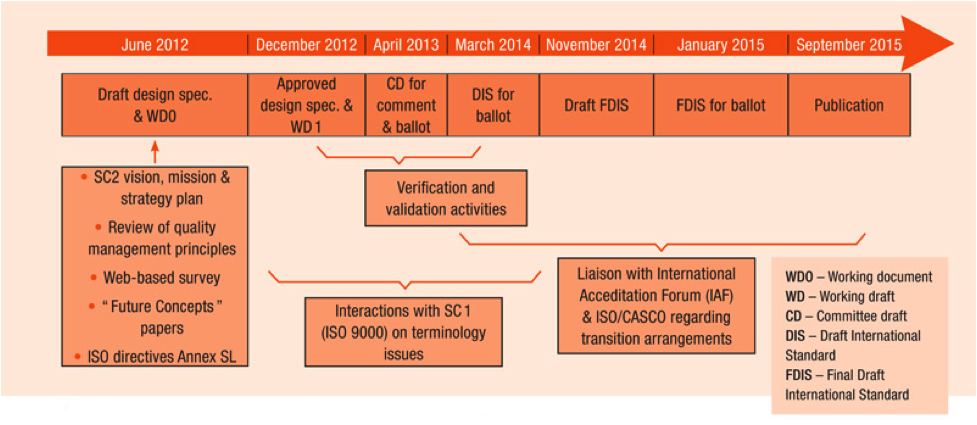
The result is that the standard takes some time and effort to be revised. In specific terms this means that at present the so-called “Committee Draft” has been published as a preliminary draft. The Committee’s timetable includes publication of the final standard in September 2015.
ISO 9001:2015 Transitional Period
There is to be a three-year transitional period. During this transitional period, organizations have time to adjust their management systems to the new standard.
New ISO 9001:2015 Structure
The new standard will include new classifications. In future there will be ten clauses. One major reason for this is because the current clause 8 (Measurement, Analysis and Improvement) will be broken down into two chapters.
Summary of New ISO 9001:2015 Content
The new ISO 9001:2015 standard will include some aspects of the current ISO 9004. As a result, the standard will be modernized and adjusted to embrace certain state-of-the-art management principles.
These include the following principles:

  1. Risk Analysis and Management – a company’s risk management plays a crucial role in the new standard. It permeates nearly every clause – from corporate planning, business processes, internal audits through to supplier management. Analyzing and managing risks is further linked to opportunities for company improvement. Please note though that formal risk management (e.g. according to ISO 31000) is not mandated.
  2. Stakeholders – effective corporate management can only be realized if the needs of all of the stakeholders can be identified, quantified and included.
  3. Process approach – Process management gets its own clause in the new standard. While the Process Approach is clearly embedded in both ISO 9001:2000 and ISO 9001:2008, it much more rigorously identified, defined, and mandated in the new ISO 9001:2015 version. Thus, it no longer only relates just to recognizing the workflows in the company, but now to managing the workflows in a more specific manner as well.
  4. Documentation – Documentation will become much more flexible. Records and documents will become so-called “documented information”.
  5. Knowledge Management – The requisite expertise has to be identified, recognized, obtained, secured, and passed on internally.
  6. Leadership – Corporate management responsibilities and tasks are significantly being expanded, with a particular emphasis on the mentoring function.

What’s Next for ISO 9001:2015?
The next stage (Draft International Standard) of the ISO 9001:2015 is scheduled to be published in April 2014. It is highly probable that the content will continue to evolve and be modified.
Please continue to visit Quality Resource Center to obtain the latest updates.


For hands-on help with the standard, see QRC’s ISO 9001 consulting services and ISO 9001 training.

Call (800) 244-5409 or request a consultation.
Understanding ISO 14001

ISO 14000 is a family of International Standards related to environmental management systems that assist organizations in –

  1. minimize how their operations (processes etc.) negatively affect the environment (i.e. cause adverse changes to air, water, or land);
  2. comply with applicable laws, regulations, and other environmentally oriented requirements, and
  3. continually improve in the above


ISO 14000 is similar to ISO 9000 quality management in that both describe the process of how a product is produced, rather than the product itself. As with ISO 9000, the certification is performed by third-party organizations rather than being awarded by ISO directly. The ISO 19011 audit standard applies when auditing for both 9000 and 14000 compliance at once.

Requirements of ISO 14001 are an integral part of the European Union‘s Eco-Management and Audit Scheme (EMAS). EMAS‘s structure and material requirements are more demanding, foremost concerning performance improvement, legal compliance and reporting duties.

The concept of an environmental management system evolved in the early nineties and its origin can be traced back to 1972, when the United Nations organized a Conference on the Human Environment in Stockholm and the United Nations Environment Programme (UNEP) was launched.  These early initiatives led to the establishment of the World Commission on Environment and Development (WCED) and the adoption of the Montreal Protocol and Basel Convention.

In 1992, the first Earth Summit was held in Rio-de-Janeiro, and served to generate a global commitment to the environment. In the same year, BSI Group published the world’s first environmental management systems standard, BS 7750. This created the model for the development of the ISO 14000 series in 1996 by the International Organization for Standardization.

As of 2010, ISO 14001 was in use by at least 223 149 organizations in 159 countries and economies.

Development of the ISO 14000 series

The ISO 14000 family includes most notably the ISO 14001 standard, which forms the foundation for organizations for the design and implementation of an effective environmental management system. Other standards included in this series are ISO 14004, which provides additional guidelines for good environmental management system practices. The critical objective of the ISO 14000 series of is “to promote more effective and efficient environmental management in organizations and to provide useful and usable tools – ones that are cost effective, system-based, flexible, and reflect the best organizations and the best organizational practices available for gathering, interpreting and communicating environmentally relevant information”.

Unlike previous “command and control” type environmental regulations, ISO 14000 was based on a voluntary approach to environmental regulation. The series includes the ISO 14001 standard, which provides guidelines for the establishment or improvement of an EMS. ISO 14001 shares many commonalities with its predecessor, ISO 9000, the international standard of quality management, which served as a model for its internal structure. Both standards can be implemented side by side, or as part of an integrated system. As with ISO 9000, ISO 14000 acts both as an internal management tool as well as a mechanism for demonstrating a company’s environmental commitment to its customers and clients.

Prior to the development of the ISO 14000 series, organizations opted to voluntarily design and develop their own EMS systems. However, this made comparisons of environmental effects between companies challenging, and therefore the ISO 14000 series was developed.

An EMS is defined by ISO as: “part of the overall management system that includes organizational structure, planning activities, responsibilities, practices, procedures, processes and resources for developing, implementing, achieving and maintaining the environmental policy”.


QRC implements environmental management systems end to end — see our ISO 14001 implementation services.

Call (800) 244-5409 or request a consultation.

ISO 13485 – Standards for Medical Devices

ISO 13485:2003 is an International Organization for Standardization (ISO) standard, published in 2003, that sets forth the requirements for a comprehensive quality management system developed for the design, marketing, manufacture, and service of medical devices.

The standard supersedes previous documents such as EN 46001 and EN 46002 (both 1997), the ISO 13485 published in 1996 and ISO 13488 (also 1996).

While it is tailored to the industry’s quality system expectations and regulatory requirements, an organization need not be actively engaged in the manufacturing of medical devices or their components to seek certification to this standard.

Although it is a stand-alone document, ISO 13485 is generally harmonized with ISO 9001. One significant difference is that while ISO 9001 requires the organization to demonstrate continual improvement, ISO 13485 requires only that the certified organization demonstrate the quality system is effectively implemented and maintained. Furthermore, the ISO 9001 requirements regarding customer satisfaction are not included in the medical device standard.

Other specific differences include:

a)     the promotion and awareness of regulatory requirements as a management responsibility. Examples of market-specific regulatory requirements include 21 CFR 820, the Quality System Regulation for medical devices sold in the United States, enforced by the U.S. Food and Drug Administration (FDA), or the Medical Devices Directive 93/42/EEC, required for doing business in the European Union

b)     controls in the work environment to ensure product safety

c)      focus on risk management activities and design control activities during product development

d)     specific requirements for inspection and traceability for implantable devices

e)     specific requirements for documentation and validation of processes for sterile medical devices

f)      specific requirements for verification of the effectiveness of corrective and preventive actions

Some see that compliance with ISO 13485 is often seen as the first step in achieving compliance with certain European regulatory requirements. For example, the conformity of Medical Devices and In-vitro Diagnostic Medical Devices according to EEC-decrees 93/42/EEC, 90/385/EEC and 98/79/EEC must be assessed before sale is permitted.

The preferred method to prove conformity is the certification of the Quality Management System according ISO 9001 and/or ISO 13485 and ISO 14971 by a Notified Body. A result of the positive assessment is the certificate of conformity allowing the CE mark and the permission to sell the medical device in the European Union.

ISO 13485 is now considered to be in line with standards and requirements for medical devices including the “Global Harmonization Task Force Guidelines” (GHTF). The GHTF guidelines are slowly becoming universal standards for design, manufacture, export and sales of various medical devices.


For help building or certifying a device quality system, see QRC’s ISO 13485 consulting services.

Call (800) 244-5409 or request a consultation.

R2:2013 Responsible Recycling of Electronic Waste Transition

Editor’s note (2026): this article describes the 2013 revision of the R2 standard for responsible electronics recycling and the transition requirements in force at the time. R2 has been revised since, and current certifications are issued against the current edition. For where the standard stands today see our R2, RIOS and e-Stewards certification consulting page.

On April 30, 2013, the R2 Solutions Board of Directors established the requirements for the transition to

R2:2013. In addition to the new R2:2013 Standard, a new R2 Code of Practice has been released, governing the implementation of all matters relating to the R2:2013 Standard and an R2 guidance document which clarifies the intent of requirements of the R2:2013 Standard.

R2:2013 was created to clarify requirements of the R2:2008 practices, improve the readability and understanding of the standard, provide additional best practices and improve the quality of certification.

The new revision was effective as of July 1, 2013.

It is not intended to serve as a standalone Environmental Health and Safety Management System, and requires a company to possess certification to ISO 14001 and ISO 45001 (formerly OHSAS 18001), or RIOS.

Certification Bodies will no longer conduct registration audits to the R2:2008 beginning six months after the effective date of R2:2013, January 1, 2014.

Renewals of existing certificates shall be based on conformance to R2:2013 prior to the end of the eighteen month transition period.

Existing R2:2008 certifications will no longer be valid eighteen (18) months after the effective date of July 1, 2013 for R2:2013.

Also effective July 1, 2013 all facilities must, per the R2 Code of Practices, have a Licensing Agreement in place with R2 Solution. They must pay their licensing fee to R2 Solutions at the time of surveillance, certification or recertification audit to either R2:2008 or R2:2013.


Each client is responsible for completing an application form and paying an online fee.

For multi-site facilities, each site must have its own License Acknowledgment receipt issued.

To obtain and maintain a licensing agreement with R2 Solutions, a company must:

a)     Engage in electronic reuse and recycling activities such as collecting, refurbishing, reselling, processing, demanufacturing, recovering assets,

b)     brokering of electronics equipment or components

c)     Abide by all requirements relating to use of the use of the R2 logo

d)     Remain current in its payments to R2 Solutions for the licensing fee.

e)     Otherwise conform to the licensing agreement


In issuing certifications and notification to R2 Solutions the following items have been identified as areas of compliance

a)     The CB must verify that the certification candidate’s with R2 Solutions is current during any audits.

b)     Multi-site certifications must clearly identify the controlling site.

c)     Each site listing will clearly demonstrate any differences in scope of activities between sites.

d)     Each site must be fully audited before added to the multi-site certificate.

e)     Campus certifications shall clearly identify the main processing location and follow any applicable requirements within the R2 code of practices.

f)      If any allowances are used, each allowance will be documented on the certificate. Allowances do not change the requirements of the R2 Standard, they remove a requirement from the scope of certification for certain types of organizations. Examples include broker allowances, co-location allowances, campus allowances, and focus material processor allowances.


The R2 Code of Practice includes some interesting changes regarding the calculation of audit time.

a)     The number of downstream vendors and their R2 certification status will affect the duration of an organization’s audit.

b)     In addition, accredited certification bodies are now required to add time to each audit to verify nonconformities from the prior audit.

c)     In addition, multi-site certifications are now allowed at initial certification, provided there is one EH&S management system and shared documented Processes; however, as part of the initial audit all members of the multi-site must be audited.

d)     Sampling can be performed on subsequent surveillance audits.

Lastly, the R2 Code of Practice details stringent requirements relating to suspension of certificates. Suspension may result for a number of reasons including, an organization knowingly selling and misrepresenting non-functioning equipment to customers. It includes organizations doing this under an associated/related e-Bay presence, even if operating under a different name or alias.

Certificates may also be suspended if an organization misrepresents the certification status of any facilities associated with the organization.


R2 has been revised since this transition; the current edition is R2v3. QRC supports recyclers through certification and transition with our R2, RIOS and e-Stewards consulting services.

Call (800) 244-5409 or request a consultation.

ISO 9001:2015 – Where Are We?

Editor’s note (2026): this article was written during the transition from ISO 9001:2008 to ISO 9001:2015 and reflects the standard as it stood then. ISO 9001:2015 is the edition in force today, with ISO 9001:2026 in development. For current requirements and transition planning see our ISO 9001 consulting services.

ISO 9001 is currently undergoing its’ first major revision in nearly 15 years. It’s an exciting time in the Quality world.

According to the draft design specification, the revised ISO 9001:2015 standard should (among other things):

  • Provide a stable core set of requirements for the next 10 years or more
  • Remain generic, and relevant to all sizes and types of organization operating in any sector
  • Maintain the current focus on effective process management to produce desired outcomes
  • Take account of changes in quality management systems practices and technology since the last major revision in 2000
  • Reflect changes in the increasingly complex, demanding and dynamic environments in which organizations operate
  • Apply Annex SL of the ISO Directives to enhance compatibility and alignment with other ISO management system standards
  • Facilitate effective organizational implementation and effective conformity assessment by first, second and third parties
  • Use simplified language and writing styles to aid understanding and consistent interpretations of its requirements

The revised Standard has significantly upgraded the clause structure as follows:

  • Clause 1 – Scope
  • Clause 2 – Normative references
  • Clause 3 – Terms and definitions
  • Clause 4 – Context of the organization
  • Clause 5 – Leadership
  • Clause 6 – Planning
  • Clause 7 – Support
  • Clause 8 – Operation
  • Clause 9 – Performance evaluation
  • Clause 10 – Improvement


Timeline

timeline-picture

Per Nigel H. Croft – Chair – ISO/TC 176/SC 2, Quality systems


Significant Changes in ISO 9001 Revision 2015 Committee Draft

1. The term “product” has been replaced by “goods and services”.

2. Two new clauses related to the context of the organization:

4.1 Understanding the organization and its context

4.2 Understanding the needs and expectations of interested parties.

3. The requirement to use the process approach has been more explicit by adding a new clause.

4.4.2 Process approach

4. The standard does not include a specific clause for “Preventive Actions”.

5. The terms “document” and “records” have been replaced with the term “documented information”.

6. Control of external provision of goods and services address all forms of external provisions.

7. The term “continual improvement” has been replaced with “improvement”.


That is quite significant.


More to come in our next BLOG…


11/15/2013


Wherever the standard goes next, the work of keeping a system certified stays the same. QRC’s ISO 9001 consulting services cover implementation, transition, and audit preparation.

Call (800) 244-5409 or request a consultation.

Welcome to Quality Resource Center

We help your business adhere and maintain quality management systems in a variety of sectors and industries. Our internal auditing training can help your business achieve ISO 9001, ISO 27001, ISO 14001, ISO 13485, AS9100, or R2 (Responsible Recycling Implementation). QRC has assisted more than 1000 organizations to implement ISO quality systems around the globe. Based in the Silicon Valley, Quality Resource Center is the nation’s oldest and most experienced Total ISO Solutions firm.


QRC has helped more than 1,000 organizations put working management systems in place since 1992. Start with our ISO 9001 consulting services, browse ISO training courses, or see the programs on our client success stories page.

Call (800) 244-5409 or request a consultation.