









ISO Consulting, Training & Auditing Services
Quality Resource Center (QRC) is a Silicon Valley–based ISO consulting firm with over 35 years of experience helping organizations achieve certification, improve operational performance, and reduce business risk.
Since the early 1990s, QRC has supported global clients across regulated and high-tech industries with practical, audit-ready management systems—not generic templates.
Trusted ISO Consulting Since 1993
QRC provides end-to-end ISO consulting, training, implementation, and auditing services for organizations pursuing certification or strengthening existing management systems.
Our consultants work alongside leadership teams to implement systems that meet certification requirements while supporting efficiency, scalability, and long-term performance.
ISO Standards We Support
Quality & Aerospace
- ISO 9001 Quality Management Systems
- AS9100 / AS9110 / AS9120 Aerospace Quality
- IATF 16949 Automotive Quality
Medical Devices & Data Security
Environmental, Safety & Sustainability
- ISO 14001 Environmental Management
- ISO 45001 Occupational Health & Safety
- R2, RIOS & e-Stewards Recycling Standards
Our ISO Consulting Services
Quality Resource Center provides complete lifecycle ISO support, including:
- ISO consulting and implementation
- Internal audits and readiness assessments
- ISO internal auditor training and certification
- Management and executive training
- Ongoing system maintenance and improvement support
Whether you require turnkey ISO consulting, targeted audit support, or internal auditor training, QRC delivers structured, proven solutions aligned with certification and business objectives.
Why Organizations Choose QRC
- Over three decades of ISO consulting experience
- Silicon Valley–based with nationwide reach
- Registrar-aware, audit-ready methodologies
- Minimal disruption to daily operations
- Practical systems built for real-world use
Speak With an ISO Expert
Call (800) 244-5409
Contact Us
QRC News & Insights
ISO 9001:2015 & ISO 14001:2015 Update
ISO 9001 and ISO 14001 are under revision with updated versions due by the end of 2015.
FAQ
- Why is ISO 9001 being revised?
All ISO standards are reviewed every five years to establish if a revision is required to keep it current and relevant for the marketplace. The future ISO 9001:2015 will respond to the latest trends and be compatible with other management systems such as ISO 14001:2015.
- Where are we at in the revision process?
ISO 9001 is currently nearing the Final Draft International Stage (FDIS ballot expected by July), the fifth stage of a six stage process, whereby the ISO subcommittee revising the standard will now go through all the comments received during the DIS vote in order to produce a final draft which will then be put forward to all ISO members for voting.
- What is the next step?
Once all comments have been considered a final draft will be produced and put forward to ISO members for voting.
- When will the new version be published?
ISO 9001:2015 will be published by the end of 2015.
- What will be the main changes to the standard?
The new version follows a new, higher level structure designed to make it easier to use in conjunction with other management system standards, with increased importance given to risk.
- I am certified to ISO 9001:2008. What does this mean for me?
Organizations are granted a three-year transition period after the revision has been published to migrate their quality management system to the new edition of the standard.
- How do I find out more?
Contact Quality Resource Center as soon as possible for more information on how the FDIS is proceeding.
TRANSITION PLANNING GUIDANCE FOR ISO 9001:2015 & ISO 14001:2015
Parties who will benefit from this guidance include but are not limited to –
- Organizations using ISO 9001:2008
- Accreditation bodies (AB’s)
- Certification bodies (CB’s)
- Training bodies and consultants
Changes
The ISO 9001:2015 revision introduces significant changes and will be published in September 2015. It is is based on Annex SL of the ISO Directives, a high-level structure (HLS) which standardizes sub clause titles, core text, common terms and core definitions to enhance compatibility and alignment with other ISO management system standards. Main changes in the new version of ISO 9001:2015 are:
- Adoption of the HLS as set out in Annex SL of ISO Directives Part One
- Explicit requirement for risk-based analysis to augment and improve the understanding and application of the process approach
- Fewer prescribed requirements
- Reduced emphasis on documents
- Improved applicability for service based organizations
- Requirement to define the boundaries of the QMS
- Increased emphasis on organizational context
- Enhanced leadership requirements
- Greater emphasis on achieving planned outcomes to improve customer satisfaction.
Transition
The International Accreditation Forum (IAF), which monitors certifications/accreditations, and the ISO Committee on Conformity Assessment (CASCO) have agreed to a three year transition period from the publication date of ISO 9001:2015. The transition period will begin in September 2015 and end in September 2018.
ISO 9001:2008 certifications will not be valid after the end of September 2018. From March 2017 all initial certifications under accreditation shall be to ISO 9001:2015.
Guidance for transition
The degree of change necessary for any organization will be dependent upon the maturity and effectiveness of the current management system, its organizational structure and practices. Thus, an impact assessment is strongly recommended in order to identify realistic resource and time implications prior to initiation of any changes.
Specific guidance for parties involved in certification and accreditation –
Organizations operating under ISO 9001:2008 are encouraged to take the following actions-
- Identify organizational gaps which need to be addressed to meet new requirements
- Design and develop an implementation plan
- Facilitate training and awareness for all affected parties
- Update existing quality management system (QMS) to meet the revised requirements and verify its’ effectiveness,
- Where applicable, liaise with your certification body for transition arrangements.
Accreditation Bodies (AB’s) are recommended to
- Inform CB’s about the transition process using the appropriate guidance and IAF produced documents,
- Plan and allocate resources for training and performing assessments to the revised standard,
- Verify that criteria used to assess auditor competence are adequate.
Certification Bodies (CB’s) are recommended to –
- Train and monitor auditors to ensure competence is demonstrated
- Interact regularly with national standard bodies
- Communicate regularly with AB’s
- Communicate with other CB’s to co-ordinate information
- Inform existing clients and share guidance on the transition process and arrangements for transition
- Plan the timing and scheduling of audit and certification activities for the revised standard
- Consider the stated transition period and current certification period
- Plan the timing of certification decisions for upgrading certificates
- Encourage current users of ISO 9001:2008 to implement ISO 9001:2015 at an early stage, taking account of any changes that may occur during the DIS stage
- Encourage new users to implement ISO 9001:2015
- Arrange audit schedules for existing client organizations
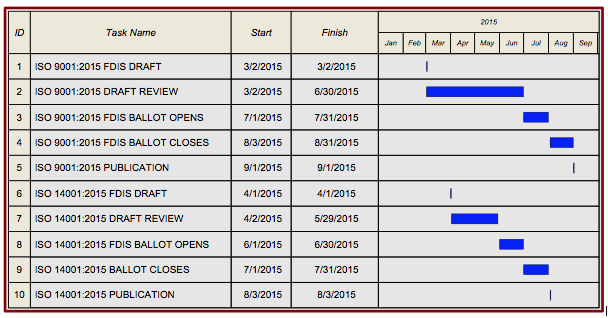
Keep checking this website for regular updates between now and the standard’s final publication.