
Silicon Valley’s Leading ISO 9001 Consultants: 30+ Years of Audit-Ready Expertise
30+ years of practical implementation, auditing, and training expertise.
Quality Resource Center (QRC) is a team of ISO 9001 consultants based in San Jose, California, with over 35 years of experience helping organizations achieve certification, improve operational performance, and reduce business risk.
Since the early 1990s, QRC has supported global clients across regulated and high-tech industries with practical, audit-ready management systems—not generic templates.
Trusted ISO 9001 Consultants Since 1992
QRC provides end-to-end ISO consulting, training, implementation, and auditing services for organizations pursuing certification or strengthening existing management systems. Our consultants work alongside leadership teams to implement systems that meet certification requirements while supporting efficiency, scalability, and long-term performance. Most engagements begin with ISO 9001 consulting services, the quality management standard behind most first-time certifications, and expand from there into aerospace, medical device, environmental, automotive, or information security requirements.
- ISO consulting and implementation
- Internal audits and readiness assessments
- ISO internal auditor training and certification
- Management and executive training
- Ongoing system maintenance and improvement support
Whether you require turnkey ISO consulting, targeted audit support, or internal auditor training, QRC delivers structured, proven solutions aligned with certification and business objectives.
Why Organizations Choose QRC
- Over three decades of ISO consulting experience
- Silicon Valley–based with nationwide reach
- Registrar-aware, audit-ready methodologies
- Minimal disruption to daily operations
- Practical systems built for real-world use
Schedule Your Complimentary Consultation
ISO Standards We Support
Quality & Aerospace
- ISO 9001 Quality Management Systems
- AS9100 / AS9110 / AS9120 Aerospace Quality
- IATF 16949 Automotive Quality
Medical Devices & Data Security
Environmental, Safety & Sustainability
- ISO 14001 Environmental Management
- ISO 45001 Occupational Health & Safety
- R2, RIOS & e-Stewards Recycling Standards
Specialized Support
- ISO 9001:2026 Transition Support
- ISO Gap Analysis
- ISO Documentation Services
- ISO Consultants in California
Three Decades of Client Results
Quality Resource Center has delivered elite client services for more than three decades, with more than 1,000 satisfied customers across a wide range of businesses and markets—from Silicon Valley manufacturers and aerospace suppliers to medical device and electronics recycling companies.
Our clients stay with us because our systems pass audits and keep working afterward. See the client logos and program examples in the sidebar, or ask us for references in your industry during your consultation.
The AI-Powered QRC Advantage
QRC pairs 35 years of hands-on auditing experience with AI-assisted documentation, gap analysis, and readiness review—so your management system gets built faster, with fewer internal hours spent writing procedures, and without the boilerplate that registrars flag.
Learn how AI-powered ISO consulting works
Schedule Your Complimentary Consultation

QRC Video InsightsFor the latest insights, guidance, and developments in ISO standards and management systems, visit the Quality Resource Center YouTube channel.
QRC News & Insights
ISO 9001:2015 & ISO 14001:2015 Update
Editor’s note (2026): this article was written during the transition from ISO 9001:2008 to ISO 9001:2015 and reflects the standard as it stood then. ISO 9001:2015 is the edition in force today, with ISO 9001:2026 in development. For current requirements and transition planning see our ISO 9001 consulting services.
ISO 9001 and ISO 14001 are under revision with updated versions due by the end of 2015.
FAQ
- Why is ISO 9001 being revised?
All ISO standards are reviewed every five years to establish if a revision is required to keep it current and relevant for the marketplace. The future ISO 9001:2015 will respond to the latest trends and be compatible with other management systems such as ISO 14001:2015.
- Where are we at in the revision process?
ISO 9001 is currently nearing the Final Draft International Stage (FDIS ballot expected by July), the fifth stage of a six stage process, whereby the ISO subcommittee revising the standard will now go through all the comments received during the DIS vote in order to produce a final draft which will then be put forward to all ISO members for voting.
- What is the next step?
Once all comments have been considered a final draft will be produced and put forward to ISO members for voting.
- When will the new version be published?
ISO 9001:2015 will be published by the end of 2015.
- What will be the main changes to the standard?
The new version follows a new, higher level structure designed to make it easier to use in conjunction with other management system standards, with increased importance given to risk.
- I am certified to ISO 9001:2008. What does this mean for me?
Organizations are granted a three-year transition period after the revision has been published to migrate their quality management system to the new edition of the standard.
- How do I find out more?
Contact Quality Resource Center as soon as possible for more information on how the FDIS is proceeding.
TRANSITION PLANNING GUIDANCE FOR ISO 9001:2015 & ISO 14001:2015
Parties who will benefit from this guidance include but are not limited to –
- Organizations using ISO 9001:2008
- Accreditation bodies (AB’s)
- Certification bodies (CB’s)
- Training bodies and consultants
Changes
The ISO 9001:2015 revision introduces significant changes and will be published in September 2015. It is is based on Annex SL of the ISO Directives, a high-level structure (HLS) which standardizes sub clause titles, core text, common terms and core definitions to enhance compatibility and alignment with other ISO management system standards. Main changes in the new version of ISO 9001:2015 are:
- Adoption of the HLS as set out in Annex SL of ISO Directives Part One
- Explicit requirement for risk-based analysis to augment and improve the understanding and application of the process approach
- Fewer prescribed requirements
- Reduced emphasis on documents
- Improved applicability for service based organizations
- Requirement to define the boundaries of the QMS
- Increased emphasis on organizational context
- Enhanced leadership requirements
- Greater emphasis on achieving planned outcomes to improve customer satisfaction.
Transition
The International Accreditation Forum (IAF), which monitors certifications/accreditations, and the ISO Committee on Conformity Assessment (CASCO) have agreed to a three year transition period from the publication date of ISO 9001:2015. The transition period will begin in September 2015 and end in September 2018.
ISO 9001:2008 certifications will not be valid after the end of September 2018. From March 2017 all initial certifications under accreditation shall be to ISO 9001:2015.
Guidance for transition
The degree of change necessary for any organization will be dependent upon the maturity and effectiveness of the current management system, its organizational structure and practices. Thus, an impact assessment is strongly recommended in order to identify realistic resource and time implications prior to initiation of any changes.
Specific guidance for parties involved in certification and accreditation –
Organizations operating under ISO 9001:2008 are encouraged to take the following actions-
- Identify organizational gaps which need to be addressed to meet new requirements
- Design and develop an implementation plan
- Facilitate training and awareness for all affected parties
- Update existing quality management system (QMS) to meet the revised requirements and verify its’ effectiveness,
- Where applicable, liaise with your certification body for transition arrangements.
Accreditation Bodies (AB’s) are recommended to
- Inform CB’s about the transition process using the appropriate guidance and IAF produced documents,
- Plan and allocate resources for training and performing assessments to the revised standard,
- Verify that criteria used to assess auditor competence are adequate.
Certification Bodies (CB’s) are recommended to –
- Train and monitor auditors to ensure competence is demonstrated
- Interact regularly with national standard bodies
- Communicate regularly with AB’s
- Communicate with other CB’s to co-ordinate information
- Inform existing clients and share guidance on the transition process and arrangements for transition
- Plan the timing and scheduling of audit and certification activities for the revised standard
- Consider the stated transition period and current certification period
- Plan the timing of certification decisions for upgrading certificates
- Encourage current users of ISO 9001:2008 to implement ISO 9001:2015 at an early stage, taking account of any changes that may occur during the DIS stage
- Encourage new users to implement ISO 9001:2015
- Arrange audit schedules for existing client organizations
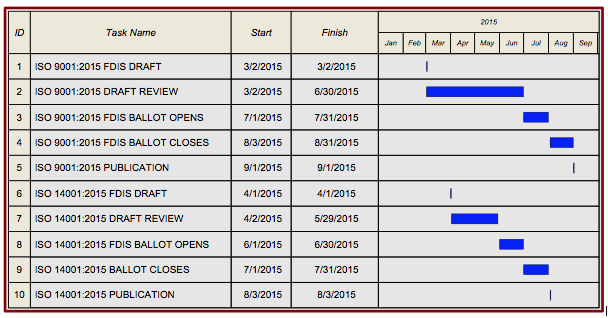
Keep checking this website for regular updates between now and the standard’s final publication.
QRC supports both standards, separately or as one integrated system — see our ISO 9001 consulting services and ISO 14001 implementation services.
Call (800) 244-5409 or request a consultation.
ISO 9001 2015 Changes
Quality Resource Center Update to Expected ISO 9001 – 2015 Changes
An official draft of ISO 9001-2015 changes has been released for comment by interested parties and a final draft standard is scheduled for release by the end of November 2014. The new standard is expected to be published in September 2015 with March 2017 for the final discontinuance of the 2008 standard and September 2018 for all concerned to fully implement the new standard.
Until a new standard is published and officially released companies should start planning for a changeover but do nothing to specifically alter their quality systems toward the new standard. Certifying audit companies will follow the above schedule unless it changes.
The 2015 standard will differ in some formal ways and it will be structured differently. The basic areas of quality control will remain the same but with renewed general emphasis on planning and management accountability. A Quality Manual will not be a formal requirement. There will be 10 sections or clauses the last seven of which will be auditable. The reason for the new standard is to promote compatibility with other standards, to recognize the various ways management is capable of satisfying the basic requirements and to respond to quality control needs discovered over time.
The seven auditable clauses will be:
- Control of the organization
- Leadership
- Planning
- Support
- Operation
- Performance Evaluation
- Improvement
Risk will be better linked to prevention but no formal risk management process will be specifically required. Risk aversion will be considered an outcome of many areas of the QMS including planning meetings. The basic principles of control and process including effects on consistency and efficiency and customer satisfaction will not change but formal quality manuals or procedure manuals will not be required. The Management Representative will not be required. Permissible exclusions will be replaced by a non-applicable designation subject to validity checks at audits.
A larger emphasis in sections 4, 5, 6, and 7 will be put respectively on:
- Organizational purpose
- Management accountability and quality objective/QMS integration
- Risk and opportunity analysis and follow-up and
- Future resources planning. But, no major overhaul will be needed. All other standards will eventually incorporate new changes but the timing is as yet not determined.
In the interim it is suggested that companies can do a gap analysis of the ISO 9001 – 2015 changes and especially with respect to the above for areas to improve. It should also be noted that the auto industry has decided as a whole through its trade organization has decided not to implement the standard due to their heavy investment in the previous standard and TS16149.
Contact us toll free for a complimentary consultation at (800) 244-5409
To speak to one of our experts immediately call us at (408) 371-9995
You can also Email Us
For help applying these changes to your own system, see QRC’s ISO 9001 consulting services and ISO 9001 training.
Call (800) 244-5409 or request a consultation.
Next Steps in the ISO 9001:2015 Revision Process
Next Steps in the ISO 9001:2015 Revision Process
The DIS phase (Draft International Standard) is the first major step in the ISO publication process. The DIS ISO 9001 revision 2015 was officially issued for public comment in early May 2014. The next steps will be the review and discussion of changes before the issuance of the FDIS (Final Draft International Standard), expected in November 2014, and the publication of ISO 9001:2015 in September 2015.
The transition period for introducing and adopting the new requirements for organizations with ISO 9001 certification will start after the new version’s publication in September 2015 and organizations will have three years to implement these into their management systems.
While the DIS is not the final release, it does reflect changes to existing requirements. As the revision process goes forward, the later FDIS will likely have minor amendments included before the final revision is issued. Quality Resource Center recommends that all organizations start familiarizing themselves now with the actual requirements of the DIS version.
What are the main expected changes to ISO 9001?
ISO 9001:2015 will have a modernized approach to quality management, characterized by the following:
- An increased emphasis on achieving value for organizations and customers. The new version will be more results- and improvement-oriented
- The new version will also have a distinct emphasis on risk management and risk-based thinking
- Increased requirements for feedback from all involved stakeholders and processes (not only from clients)
- Greater emphasis on involvement of top management
- A revised structure to align with all other ISO management system standards and facilitate integration with other management systems
- The standard will be more readily applicable by service industries and organizations
- More flexibility on the type and use of documentation; simplified requirements for documented procedures (no longer a “quality manual”)
- What has not changed is that the customer remains the primary focus
Quality Resource Center will publish information on new developments on a regular basis. Our team is available to support you with this transition and can provide further information and assistance on this new draft standard.
QRC guides organizations through every ISO 9001 revision — see our ISO 9001 consulting services.
Call (800) 244-5409 or request a consultation.
Read all QRC news and insights
Speak With an ISO Expert
Tell us where you are—new certification, a transition, a failed audit, or a system that needs to be usable again—and we will tell you exactly what it takes.
Call (800) 244-5409